After watching another TV interview with an unschooling family done by the mainstream media, I found myself again reacting to the fact that the interviewer (Juju Chang, who also interviewed us) was asking 'schooling' questions. I thought to myself, why doesn't she ask unschooling questions? Then I thought, well, what are unschooling questions? If I had an opportunity to write the questions, what questions would I write? How do we talk about our lives and our kids "as if school didn't exist"? So, here are some questions I wish they had asked me (and the answers I would have given them):
1. How do you define your lifestyle?
Our lives are focused on our family - we want each person to be happy and successful and to grow as people. We are aware of each others wants and needs, and we help each other accomplish our goals. We tend to make decisions as a family - everyone has a say in the way we live. As parents, our job is to ensure our children (and each other) has the maximum exposure to the world at large. We set goals, go on adventures and to activities, visit family and friends, and pursue our hobbies and interests.
2. What was the most important factor in this decision?
Christine and I started out with a family oriented lifestyle - home birth, extended nursing, attachment parenting. We initially sent the kids to school, but we saw changes in them that saddened us. Our daughter achieved perfect scores on the standardized tests, but she was labeled with problems and was miserable. We ultimately felt that we could do a better job of educating them. Christine did a lot of research into home schooling, and we decided on unschooling after a careful review. The clincher was meeting some unschooling families at a conference - the joy, the love, the wonderful children really convinced us that this was the right path for us.
3. How do you describe your relationship with your children?
While we are clearly their parents, and as such are responsible for their welfare and safety, we have a close relationship built on trust, respect, honesty, and love. We respect them as people - we treat them at least as well as we do other adults. We count on their input and opinions, and we enjoy their company. We're pleased that they would prefer to have us around more often than not.
4. What kinds of things are your kids interested in?
Their interests change pretty often. Right now, Shaun is interested in swordfighting and the associated role playing that accompanies it during his classes at Guard Up; he is an avid World of Warcraft player, and has reached some of the highest levels available; and he reads books geared towards fantasy and mythology (both Greek and Roman) and Japanese Manga. Kimi loves watching and reading about forensic science and police drama, and is also very interested in Japanese Manga. Both kids like to travel - they've been all over the country, as well as outside the US, and look forward to planning trips.
5. What are some of your favorite family activities?
As a family we like to travel, go to movies, have long discussions about all kinds of topics, and watch certain TV shows. We also tend to read a lot of the same books. Christine is involved in Guard Up, where both kids take classes; Kimi and I like to work together on the motorhome and some landscaping, especially when it involves cutting down trees.
6. What kinds of changes have you seen in your children over the past 1-3 years?
I've been proud to have watched them grow into young adults. They continue to be very confident in their decisions. They are able to discuss mature topics, and they have developed important relationships with friends all over the country.
7. What are the biggest disadvantages of unschooling?
While I don't think we lead perfect or idylic lives, I don't see a disadvantage in our lifestyle. We get to spend an incredible amount of time with our children, and we enjoy each other's company. We share so much, and hide so little. Our children will only be young for a little while - I'm happy we can maximize our time with them and watch them develop and grow.
Here are some questions for our kids. I won't answer these :-)
1. What is your favorite activity?
2. What is something that you used to be interested in and now don't find so interesting?
3. What is the most unusual thing you've done in the past year?
4. Is there something you're looking forward to in the next year?
So, if you're out there and you're looking to get some insight into an unschooling family, try to ask these kinds of questions, and you may be quite surprised at how you can appreciate the choice we've made for educating our children.

Custom Search
Canyonlands National Park, Utah
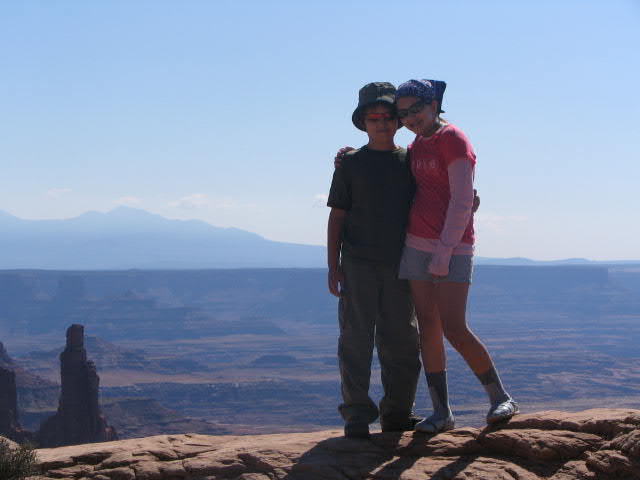
Kimi & Shaun - On Top of the World!
Showing posts with label media. Show all posts
Showing posts with label media. Show all posts
Friday, June 4, 2010


Sunday, May 2, 2010
If I'm right, are you wrong?
We've been thinking about why so many people respond so negatively to the portrayal of our unschooling lifestyle. Of course, many people just don't take the time to think about it - they react emotionally, and outright reject it without understanding what we're doing (frustrating - there's just no discussion to be had there). But others clearly put some thought into it, and ask some decent questions (very school oriented, but they are loooking for some information and can't ask from our point of view very easily), and still come away very negative. There are probably many reasons for this, but one of them is likely this: if you accept our choice for educating our children, then it invalidates what you are doing for your kids, and would make you wrong. (People don't like to be told, or to find out, that they are wrong.)
I can hear some people saying "yup, it's true - we're right, and they're wrong!" but that's not my perspective. I believe that many of us are really trying to say "we strongly believe that this choice is best for our children; just as we are free to decide what is best for our family, you are free to decide what is best for your family." I also believe that unschooling (especially radical unschooling) is *not* for everyone. I think, for example, that a family could be a good candidate to move to unschooling if they meet the following criteria:
1. The school system is failing your kid(s) in some important way (where 'important' is up to the kids and parents, not from the institution's perspective, e.g. just test scores).
2. At least one parent is willing to devote the time and energy required to unschool.
3. You are prepared to change the way you look at education and how kids think, learn, and behave.
Now, this is just one way to look at it, and I'm not trying to put all unschoolers in the same category. However, many people cannot provide a reasonable environment (and mindset) at home for unschooling; likewise, there are many kids who can handle (and are handling) the school lifestyle and are thriving. It's not my intention to tell someone that if school is working for them, or if they are not ready to devote the time and consider our viewpoint, that they should unschool anyway. I have heard the story from mmany unschooling parents of how they came to embrace unschooling, and in many cases they didn't know all along that they would unschool (it's true for some, but not most); rather, it was a journey that had many challenges for one or both parents. We have no idea how a particular family got to where they are (schooling or otherwise), so we can't say what they should do now in their lives.
So I need to make sure my message comes across as: "I've found a way of educating my kids that works best for us; it's not one that will work for everyone. Looks like you've found a way that works for you - that's great! After all, it's all about making sure our kids are ready for their future, right?" Or something like that. Of course, for those who really want to understand what we do, and to see if it's for them, I'm happy to engage in a deeper, more meaningful conversation.
If people are willing to listen to our core messages, and they are willing to accept that we have the right to make this choice, and they are willing to accept that our decision does not invalidate their decision, then I think we've accomplished a lot.
I can hear some people saying "yup, it's true - we're right, and they're wrong!" but that's not my perspective. I believe that many of us are really trying to say "we strongly believe that this choice is best for our children; just as we are free to decide what is best for our family, you are free to decide what is best for your family." I also believe that unschooling (especially radical unschooling) is *not* for everyone. I think, for example, that a family could be a good candidate to move to unschooling if they meet the following criteria:
1. The school system is failing your kid(s) in some important way (where 'important' is up to the kids and parents, not from the institution's perspective, e.g. just test scores).
2. At least one parent is willing to devote the time and energy required to unschool.
3. You are prepared to change the way you look at education and how kids think, learn, and behave.
Now, this is just one way to look at it, and I'm not trying to put all unschoolers in the same category. However, many people cannot provide a reasonable environment (and mindset) at home for unschooling; likewise, there are many kids who can handle (and are handling) the school lifestyle and are thriving. It's not my intention to tell someone that if school is working for them, or if they are not ready to devote the time and consider our viewpoint, that they should unschool anyway. I have heard the story from mmany unschooling parents of how they came to embrace unschooling, and in many cases they didn't know all along that they would unschool (it's true for some, but not most); rather, it was a journey that had many challenges for one or both parents. We have no idea how a particular family got to where they are (schooling or otherwise), so we can't say what they should do now in their lives.
So I need to make sure my message comes across as: "I've found a way of educating my kids that works best for us; it's not one that will work for everyone. Looks like you've found a way that works for you - that's great! After all, it's all about making sure our kids are ready for their future, right?" Or something like that. Of course, for those who really want to understand what we do, and to see if it's for them, I'm happy to engage in a deeper, more meaningful conversation.
If people are willing to listen to our core messages, and they are willing to accept that we have the right to make this choice, and they are willing to accept that our decision does not invalidate their decision, then I think we've accomplished a lot.
Thursday, April 29, 2010
"But you're missing the point!"
I'm reading (and listening to) more fallout from our TV appearances, and I find myself saying "you're missing this point!" way too much. So, once again I try to go at it from the other side. What's the point? How do I say it more clearly so that others will hear it more clearly?
First, I hear a couple of times that unschooling (and homeschooling) parents are the ones who are more likely to be more involved in their kids' education, rather than less, just by the simple act of making a specific, and uncommon, choice on their education (and I even hear some of the critics agree with that point!). Next, I hear that "no kid will chose to learn algebra" or "how will they learn history" or "they need to get the fundamentals" before making their own choices. Then I hear that kids "don't know what they don't know, and need to be exposed to a lot of things" so that they know what they like and should focus on.
Too many people seem to make the following assumptions:
1. 'Kids make choices' means 'Parents do nothing.'
2. 'No arbitrary rules' means 'Free for all.'
3. 'No school teachers' means 'No learning.'
All of these assumptions must be accompanied by the assumption that the parents do not care about their kids.
So, since I'm a math/logic guy at heart, I ask that at least for a moment we accept the following assumptions:
1. Parents who unschool care about their children's education.
2. Parents who unschool want their kids to succeed.
3. Parents who unschool live in the real world, and are aware of all the concerns about unschooling and are aware of the rules and norms of society.
4. Parents who unschool spend a lot of effort and energy on their kids' education.
Let us then postulate that:
1. Unschooling parents want their kids to be exposed to as much as possible (assumptions #1 #3, and #4). Unschooled kids who are exposed to a lot must see some part of the world, and by extension, have to learn about it.
2. Unschooling parents demonstrate behaviors they want their kids to emulate (assumptions #2, #3, and #4).
3. Unschooling parents will seek out what they believe is the best for their kids, and will take advantage of all forms of learning, including classes, books, lectures, programs, other experts, and whatever else they need to get their kid whatever s/he needs (assumptions #1-4).
4. Unschooling kids who are using many forms of learning, and who are exposed to many things in the real word must live by the rules of society (and the museum, and the movie theater, and the bookstore, and the library, and so on...) (assumptions #1-4).
Is this a stretch? Is the acceptance of my assumptions an unreasonable request? If not, are the results of those assumptions too much to swallow? If not, then is it at least likely (maybe as much as the school system) that the kids will in fact learn the basics, see a lot, get the opportunity to find their passions (even though they may change over time), and that they will be ready to enter the real world as productive adults?
First, I hear a couple of times that unschooling (and homeschooling) parents are the ones who are more likely to be more involved in their kids' education, rather than less, just by the simple act of making a specific, and uncommon, choice on their education (and I even hear some of the critics agree with that point!). Next, I hear that "no kid will chose to learn algebra" or "how will they learn history" or "they need to get the fundamentals" before making their own choices. Then I hear that kids "don't know what they don't know, and need to be exposed to a lot of things" so that they know what they like and should focus on.
Too many people seem to make the following assumptions:
1. 'Kids make choices' means 'Parents do nothing.'
2. 'No arbitrary rules' means 'Free for all.'
3. 'No school teachers' means 'No learning.'
All of these assumptions must be accompanied by the assumption that the parents do not care about their kids.
So, since I'm a math/logic guy at heart, I ask that at least for a moment we accept the following assumptions:
1. Parents who unschool care about their children's education.
2. Parents who unschool want their kids to succeed.
3. Parents who unschool live in the real world, and are aware of all the concerns about unschooling and are aware of the rules and norms of society.
4. Parents who unschool spend a lot of effort and energy on their kids' education.
Let us then postulate that:
1. Unschooling parents want their kids to be exposed to as much as possible (assumptions #1 #3, and #4). Unschooled kids who are exposed to a lot must see some part of the world, and by extension, have to learn about it.
2. Unschooling parents demonstrate behaviors they want their kids to emulate (assumptions #2, #3, and #4).
3. Unschooling parents will seek out what they believe is the best for their kids, and will take advantage of all forms of learning, including classes, books, lectures, programs, other experts, and whatever else they need to get their kid whatever s/he needs (assumptions #1-4).
4. Unschooling kids who are using many forms of learning, and who are exposed to many things in the real word must live by the rules of society (and the museum, and the movie theater, and the bookstore, and the library, and so on...) (assumptions #1-4).
Is this a stretch? Is the acceptance of my assumptions an unreasonable request? If not, are the results of those assumptions too much to swallow? If not, then is it at least likely (maybe as much as the school system) that the kids will in fact learn the basics, see a lot, get the opportunity to find their passions (even though they may change over time), and that they will be ready to enter the real world as productive adults?
Wednesday, April 21, 2010
What we wish the media shared about us...
We’ve been proactively exposing our kids for years to the many different ideas & things that exist in the world & they do choose to learn about interesting & complicated stuff, such as mythology, forensic science, geography, geology, opera, Shakespeare. They have been reading since they were little - before school-age - & read every single day from numerous types of literature.
Kimi & Shaun can learn organically or formally - it’s their choice how they get their information. They didn’t need classes to learn those things already mentioned as well how to swim, ski, hike, climb rock walls, read, figure out math problems, type, spell & write. Things they have chosen to attend classes for include zoo school, a NASA simulation, sword fighting & historical weapons, gymnastics, Japanese culture, French, creative writing & robotics.
There are a large number of radical unschoolers who are currently in college or already part of the work force. They are positively engaged in society, not lost souls who can’t hold a job or take care of themselves. Most 13 or 15 year olds don’t feel ready for college, no matter how they are being educated, so judging unschoolers differently is hypocritical. Our kids will pursue whatever form of higher education they want because of specific goals they have set for themselves, not just because that’s what everyone is supposed to do.
There is a huge difference between no rules and no arbitrary rules. When rules feel arbitrary people of all ages will fight back, sometime subtly, sometimes blatantly. Our family “rules” are actually principles, with trust, respect & honesty always supporting the decision-making process. As they internalize these principles, they are armed with the character tools needed to make logical, informed decisions and behave with honor and integrity, no matter how amazing or mundane the task.
Typical day? Fortunately, unschoolers don't have a monotonous routine 5 days a week, 9 months out of the year! "Typical" depends on the type of day.
When we’re traveling, we have places to visit & things to do based upon whether the place is new to us or not. This could include going to museums, zoos, national parks, cities, beaches, or musical or theatrical events.
When we’re home, the kids have various activities that they are engaged in, which could be done alone, with each other or us, or with a group of friends. Activities include reading about, researching or exploring something that they are currently interested in, socializing with friends, working on projects, running errands or helping around the house. Some days they have their classes to go to. It varies & they are always busy & engaged in some activity.
Our kids are thoroughly engaged in their community - not being in school frees them to interact with many different people, doing different jobs, of different ages & backgrounds. Their friendships & acquaintances provide them with a wider point of view of life styles that are different from their own. The issues of bullying, cliques & negative peer pressure are not a part of their lives - they can't imagine why people would treat others that way.
Why can't learning be a joyful thing? Why do so many people want children to "endure" - what does that say about their own lives? And why do so many people think so little about the capabilities & work ethic of children, teens & young adults? If so many are so lazy, well, were they unschooled or schooled - & if they were schooled (which we all know most were) then how can you attack unschoolers instead of the school system that begot these "lazy" adults?
I'm not saying the public school is all bad, even when it doesn't have a 100% success rate. There are families that are not equipped, for various reasons, to unschool their children. But the system is far from perfect. Unschoolers are not perfect, but somehow we are expected to do better than what the school system is able to do. I hope that those families looking for alternatives can find useful, factual information to help them make decisions that enhance their lives & the lives of their children.
JK Rowling: The fringe benefits of failure | Video on TED.com
JK Rowling: The fringe benefits of failure | Video on TED.com
What powerful words from an extremely talented wordsmith!
Live, Love, Learn & Trust!
In Massachusetts, we celebrate Patriots' Day, a yearly holiday that commemorates the Battles of Lexington & Concord on April 19, 1775.
On April 19, 2010, our family unexpectedly found itself in a different kind of battle - a battle to defend our reputation & the image of radical unschooling. We had allowed a national news organization, Good Morning America, to film us in and around our home as we explained the educational & parenting philosophies that are encompassed by Radical Unschooling. Due to some heavy editing & some staged scenarios, as requested by GMA, our family ended up looking like a bunch of lazy uninformed crazies. The word "crazy" was even used during the intro by George Stephanopoulos. Their version of our lives didn't resemble what we do at all!
Fortunately, after a huge uproar on their website, they realized that they could have done a better job & had done us a disservice. We were contacted soon after the segment aired & were invited to fly to NYC to appear on their show the next morning - they wanted to provide us with a do-over. With more than a little trepidation, we decided to go.
We are so glad we did! Everyone we met at Good Morning America treated us with respect & kindness. They had us stay at a nice hotel right next to the studios & comp'ed our meals while in the City. Juju made a point of talking to all of us before we went on air & was very kind & encouraging. Meeting George right before the segment, he was warm & self-deprecating. I have to say, I was impressed that he was willing to figuratively "take it on the chin" for the bias they displayed the previous day.
Even though we only had a few minutes to address so many issues raised by our original segment, we think we were able to get at least some key points out there. The last thing we want is to make it harder for other unschoolers to be respected & understood as they live their lives & care for their children.
We're hoping that this new media interest will lead to healthy dialogue about learning & education, respectful family relationships, & helping all children find their inner passions and abilities.
Thank you for reading - we hope you join in the discussion with an open heart & an open mind.
On April 19, 2010, our family unexpectedly found itself in a different kind of battle - a battle to defend our reputation & the image of radical unschooling. We had allowed a national news organization, Good Morning America, to film us in and around our home as we explained the educational & parenting philosophies that are encompassed by Radical Unschooling. Due to some heavy editing & some staged scenarios, as requested by GMA, our family ended up looking like a bunch of lazy uninformed crazies. The word "crazy" was even used during the intro by George Stephanopoulos. Their version of our lives didn't resemble what we do at all!
Fortunately, after a huge uproar on their website, they realized that they could have done a better job & had done us a disservice. We were contacted soon after the segment aired & were invited to fly to NYC to appear on their show the next morning - they wanted to provide us with a do-over. With more than a little trepidation, we decided to go.
We are so glad we did! Everyone we met at Good Morning America treated us with respect & kindness. They had us stay at a nice hotel right next to the studios & comp'ed our meals while in the City. Juju made a point of talking to all of us before we went on air & was very kind & encouraging. Meeting George right before the segment, he was warm & self-deprecating. I have to say, I was impressed that he was willing to figuratively "take it on the chin" for the bias they displayed the previous day.
Even though we only had a few minutes to address so many issues raised by our original segment, we think we were able to get at least some key points out there. The last thing we want is to make it harder for other unschoolers to be respected & understood as they live their lives & care for their children.
We're hoping that this new media interest will lead to healthy dialogue about learning & education, respectful family relationships, & helping all children find their inner passions and abilities.
Thank you for reading - we hope you join in the discussion with an open heart & an open mind.
Subscribe to:
Posts (Atom)